
Should Employers Monitor Employee LinkedIn Profiles?
Published: 27 September 2026
Should Employers Monitor Employee LinkedIn Profiles?
Monitoring employees' LinkedIn activity, including profile updates, new connections, and posts, directly questions trust and employer brand. Our data shows that if you hire well, develop people, and reward them fairly, watching their LinkedIn profile indicates a deeper retention problem, not a solution. In 2026, organisations with strong employer brands focus on empowerment, not surveillance.
Key Takeaways
- An individual's LinkedIn profile belongs to the employee, not the employer. LinkedIn profiles pre-date and outlast any single employer.
- Excessive monitoring damages trust, which directly increases the risk of voluntary employee turnover.
- Supporting employees to build their professional presence benefits both the individual and the employer brand.
- Treating LinkedIn updates as a loyalty test signals a culture problem, not a LinkedIn problem.
- Strong retention comes from fair pay, genuine development, and a workplace people want to stay in, not surveillance.
Why Monitoring Erodes Trust and Increases Turnover
Does excessive monitoring actually increase employee turnover?
Excessive monitoring increases employee turnover because it signals distrust, which reduces psychological safety. When employees feel watched rather than valued, their emotional commitment to the organisation weakens. This reduced commitment is a direct precursor to job-seeking behaviour. The monitoring itself becomes the trigger for the flight risk it was designed to prevent.
According to the Recruitment and Employment Confederation (REC), employer brand and workplace culture are primary factors that candidates evaluate before accepting a role. An organisation known for surveillance-style management will find it harder to attract and retain the talent it needs. Our experience with over 150 recruitment agencies across the UK confirms that agencies retaining their best consultants invest in their people, not in monitoring their LinkedIn profiles.
What does UK employment law say about monitoring employees online?
UK employment law, governed by the UK GDPR and the Data Protection Act 2018, requires employers to have a lawful basis for monitoring employee activity. Monitoring must be proportionate, transparent, and necessary. Covert or disproportionate surveillance of personal professional profiles, such as LinkedIn, carries significant legal and reputational risk for employers who cannot demonstrate a clear, documented justification.
The Information Commissioner's Office (ICO) guidance on employee monitoring states that workers must be informed about any monitoring and its purpose. Monitoring a personal LinkedIn profile without clear policy and disclosure is unlikely to meet that standard. Employers must satisfy all three of the following ICO requirements:
- Inform employees: Workers must be told what is being monitored and why, before any monitoring begins.
- Establish a lawful basis: Employers must identify a specific, documented legal ground under UK GDPR for processing the personal data gathered.
- Apply proportionality: The scope of monitoring must not exceed what is strictly necessary for the stated purpose.
How Employers Can Support LinkedIn Use Constructively
How can employers support LinkedIn use without crossing into surveillance?
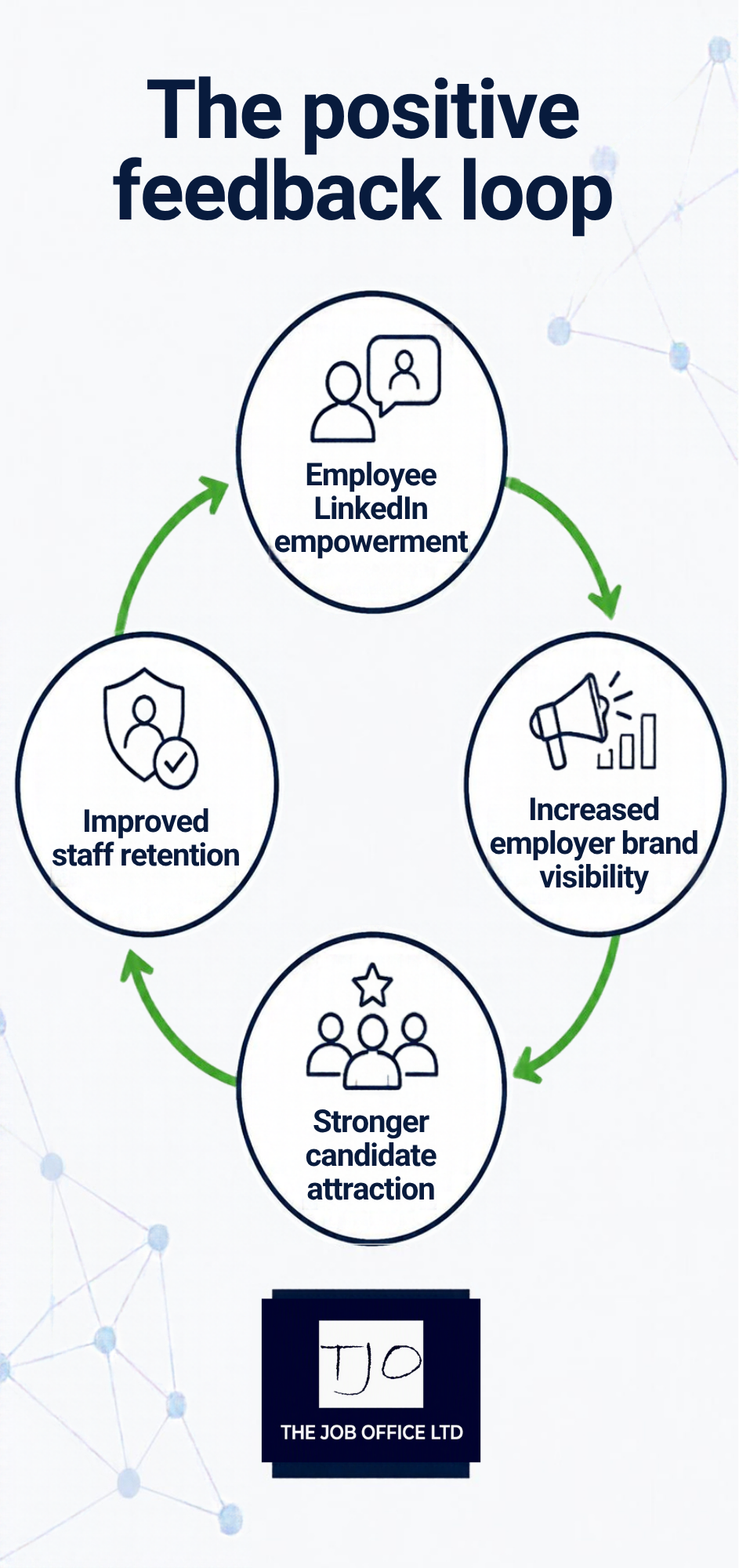
Employers can support LinkedIn use constructively by building a clear social media policy that encourages professional visibility, setting expectations around confidentiality, and actively celebrating employee thought leadership. This approach builds employer brand rather than eroding it. The distinction is between empowering employees and policing them, fostering a positive digital presence.
In The Job Office Ltd.'s work placing recruitment professionals across the UK, the agencies attracting the strongest candidates possess a visible, positive employer brand. That brand is often built, in part, by engaged employees sharing their expertise publicly on LinkedIn.
What practical steps can employers take to encourage positive LinkedIn engagement?
Employers can implement several practical steps to encourage positive LinkedIn engagement. These actions foster a supportive environment where employees feel valued and empowered to build their professional networks. This approach strengthens the employer brand and contributes to a positive workplace culture.
- Step 1: Create a transparent social media policy. Develop a policy that sets clear expectations without restricting professional activity, focusing on confidentiality and brand representation.
- Step 2: Encourage employees to share company content. Provide employees with approved content to share, turning individual profiles into valuable employer brand assets.
- Step 3: Recognise and reward visibility. Acknowledge and celebrate employees who actively engage on LinkedIn, treating their visibility as an asset rather than a threat.
- Step 4: Address retention concerns directly. Implement regular pay reviews, conduct development conversations, and perform culture audits to proactively address underlying reasons for potential employee turnover. If you're unsure where to start, our TJO Business Consultancy team works directly with agency leaders on retention and employer brand strategy.
Good Retention Does Not Need Surveillance
Sustainable staff loyalty stems from continuous investment in workplace culture rather than digital policing. If an employer hires good people, develops them, rewards them fairly, and creates an environment where team members want to stay, there should be little need to watch their LinkedIn activity. Our 40+ years in recruitment show that organisations monitoring LinkedIn as a retention strategy often fail to address underlying reasons for employee departure. The monitoring is a reaction to a culture problem, not a fix for one.
The better question isn't
"what is my employee posting on LinkedIn?"
It's
"why would my employee be looking for another role?"
Answer that honestly, and the LinkedIn question largely answers itself. This proactive approach fosters loyalty and reduces the need for intrusive monitoring. In 2026, leading recruitment firms prioritise employee well-being and professional growth, leading to higher retention rates and stronger employer brands.
About the Author
Jamie Rafferty - Founder & Managing Director, The Job Office Ltd
With 40+ years in recruitment and 20+ years as a Rec2Rec specialist, I bring deep industry knowledge and a UK-wide network. Starting as a trainee consultant in 1983, I've held roles from branch manager to MD. Today I partner with agencies to secure top recruitment talent, guided by honest advice, trust, and relationships built over four decades.
View Jamie's full profile | 07969 620324 | jamie@thejoboffice.com
Frequently Asked Questions
Does UK data protection law permit systematic monitoring of staff social media?
UK data protection law requires employers to establish a documented lawful basis, such as legitimate interests, alongside a Data Protection Impact Assessment before conducting systematic monitoring. The Information Commissioner's Office explicitly warns that routine surveillance of private activity often breaches proportionality principles. Employers must inform staff through transparent privacy notices prior to review.
How should recruitment agency leaders react when a consultant switches on open-to-work signals?
Recruitment directors should initiate transparent career progression conversations rather than issuing disciplinary warnings when consultants activate job-seeking features. High-performing recruiters often explore market rates to benchmark their commission structures. Using this signal as an opportunity to review billings, pipeline support, and career milestones frequently resolves discontent before candidates approach external headhunters.
Can employment contracts legally restrict recruiters from taking LinkedIn connections to a competitor?
Post-termination restrictive covenants cannot grant an agency ownership over an individual's personal network connections formed on digital platforms. Courts enforce non-solicitation clauses against specific client lists rather than broad connection counts. Clear employment contracts must define proprietary company databases separately from public contacts to hold legal weight during disputes.
Should recruitment firms audit prospective hires' profiles during the interview stage?
Pre-employment screening of candidate social profiles is legally permissible only when assessing role-related qualifications, work history, and professional conduct. Reviewers must disregard protected characteristics to avoid discrimination claims under the Equality Act 2010. Hiring managers should standardise background checks across all applicants to maintain fairness throughout the hiring process.
What governance framework should recruitment leaders implement instead of informal profile surveillance?
Agencies require a clear social media policy that defines acceptable brand representation and confidential client data handling. Establishing objective output metrics, such as placement ratios and client acquisition figures, removes the temptation to track personal online activity. Regular quarterly performance reviews provide superior insight into consultant engagement compared to ad-hoc digital oversight.
Ready to Strengthen Your Recruitment Team's Retention?
If you're an agency founder or director asking whether your consultants are looking to leave, the more productive question is whether your culture, compensation, and career pathways give them a reason to stay. Jamie Rafferty works directly with recruitment agency leaders across the UK to identify retention risks and build teams that last.
Speak to Jamie about your agency's hiring and retention strategy: call 07969 620324 or email jamie@thejoboffice.com.
For a broader view of how the UK recruitment market is performing in 2026, read our analysis of whether the UK recruitment market is finally turning a corner.
Please note that for your privacy no data from this form is stored in this website, beyond the legitimate interest period. View our privacy policy
